
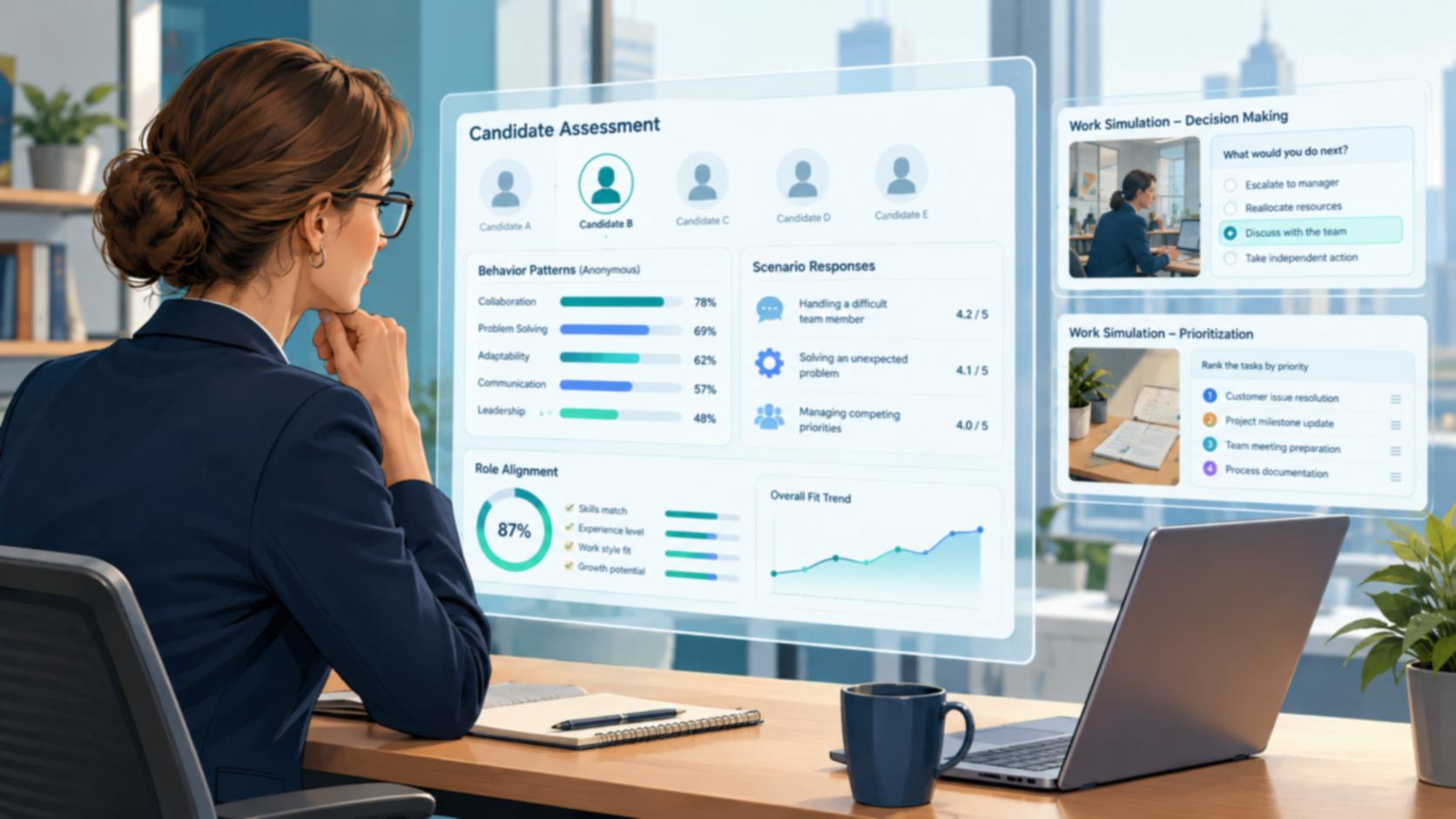
Predictive psychometric testing can help organizations reduce early employee turnover by adding structured behavioral evidence to hiring decisions. Rather than relying only on resumes, interviews, and self-reported qualifications, these assessments evaluate how candidates approach role-relevant situations. The resulting data can help hiring teams assess practical skills, problem-solving approaches, adaptability, and alignment with the demands of a role before an offer is made.
Turnover has several possible causes, including compensation, management, working conditions, career opportunities, and a mismatch between the person and the role. Psychometric testing does not remove those factors. It can, however, help identify potential mismatches earlier by making behavioral information part of the selection process.
The central principle is straightforward: a hiring decision is stronger when it considers evidence of how a candidate responds to relevant work situations, not only what the candidate reports on a CV. This approach is commonly described as predictive hiring when assessment data is used to estimate future role alignment.
Why resumes provide an incomplete view of role alignment
A resume records a candidate’s work history, qualifications, and stated achievements. It is useful for establishing baseline experience, but it does not directly show how a person prioritizes tasks, solves problems, responds to changing conditions, or works through a realistic job scenario.
These factors can matter when a role requires particular working patterns or practical capabilities. For example, an operations position may call for consistent decision-making under time constraints, while a customer-facing role may require a structured response to competing requests. A resume alone cannot observe those behaviors.
Manual CV review can therefore be supplemented with skills-based evidence. Organizations considering this shift may also find value in replacing resume screening with skills-based validation for high-volume hiring. The objective is not to disregard professional experience, but to evaluate it alongside more direct evidence of job-relevant behavior.
Understanding predictive hiring and behavioral modeling
Predictive psychometrics applies structured assessment methods to evaluate characteristics and behaviors that may be relevant to a job. In recruitment, the term generally refers to using assessment data to inform an estimate of a candidate’s suitability for a role.
Behavioral modeling is the process of analyzing patterns in that data. A model may compare assessment responses with job-related criteria or with validated profiles associated with success in a particular role. The output should be treated as decision support, not as an automatic hiring decision.
Unlike a static questionnaire that depends largely on self-description, an interactive assessment can collect responses to a defined scenario. For instance, a candidate may be asked to organize competing priorities, interpret information, or choose an action in a simulated work situation. Such exercises can provide observable data about the candidate’s approach to the task.
Psychometric assessments require careful design and validation. The behaviors being measured should be relevant to the role, the scoring method should be consistently applied, and results should be reviewed alongside other appropriate hiring evidence. A model that is not regularly evaluated can reproduce poor assumptions rather than improve decision-making.
How assessments forecast job suitability and retention risk
Predictive behavioral modeling begins with role-relevant evidence. Interactive, role-specific simulations can record how a candidate responds to a practical problem rather than asking the candidate to describe how they would respond. The assessment may capture choices, response patterns, or demonstrated problem-solving within the defined exercise.
That information can then be analyzed against criteria linked to the role. Depending on the assessment design, these criteria may include practical reasoning, adaptability, task prioritization, or other job-relevant behaviors. The purpose is to identify alignment between the candidate’s demonstrated approach and the needs of the position.
When retention is the concern, the focus is long-term role alignment rather than a narrow prediction of short-term performance. A candidate may have the technical qualifications for a job while still facing a mismatch with its pace, decision-making demands, or working environment. Structured assessment data can help surface questions that a CV review may not reveal.
Cultural fit also requires careful definition. It should not mean selecting people who resemble the existing team in background or personality. A more defensible approach is to assess role-relevant work behaviors and organizational expectations, such as how work is coordinated, how decisions are made, or how responsibilities are handled. This distinction helps keep the evaluation focused on the job rather than subjective similarity.
The relationship between psychometrics and employee turnover
Using psychometric assessments for employee retention does not guarantee that an employee will remain with an organization. It can reduce a source of avoidable risk when early departures are connected to a poor match between a candidate’s demonstrated behaviors and the role’s requirements.
External industry evidence indicates that the effect can be measurable. HRTech Series reports that some studies have shown up to a 39% decrease in first-year turnover after psychometric assessments were implemented in hiring. Results will vary by role, assessment quality, hiring process, and the conditions employees encounter after joining.
Objective evaluations can also support more consistent screening by applying the same job-related criteria across candidates. When demographic information is not central to an initial assessment, decision-makers can place greater emphasis on demonstrated capabilities. This does not make a process automatically free of bias; assessment content, scoring models, and human review still require scrutiny.
For hiring teams, the operational value lies in making earlier decisions with clearer evidence. Better-defined assessments can reduce time spent reviewing candidates who do not meet role-relevant criteria, while reserving interviews for deeper evaluation of shortlisted applicants.
Adopting predictive psychometrics responsibly
Organizations considering predictive psychometrics should begin with a specific hiring problem. A high early-turnover rate in one function may require a different assessment approach than a need to evaluate practical problem-solving in another. The assessment should reflect real job demands rather than generalized assumptions about personality.
- Define role-relevant criteria: Identify the practical behaviors and capabilities needed for success in the position.
- Use assessments as one source of evidence: Combine results with structured interviews, relevant experience, and human judgment.
- Review fairness and relevance: Examine whether the assessment measures job-related criteria consistently across candidates.
- Validate outcomes over time: Compare assessment signals with retention and role outcomes, then refine the process where needed.
- Explain the process to candidates: Clear communication about the purpose and format of an assessment can support a more transparent candidate experience.
SectorPro’s Predictive Psychometrics Module applies AI-powered predictive analytics to assess cultural fit and role alignment through assessments. Within a properly designed hiring process, this capability can help organizations use behavioral evidence when evaluating turnover risk. For broader context on the approach, SectorPro also covers predictive psychometrics in hiring for modern HR teams.
Operations managers and SME owners assessing this approach can schedule a free demo with SectorPro to examine how predictive psychometrics could be applied to their hiring workflow.
