
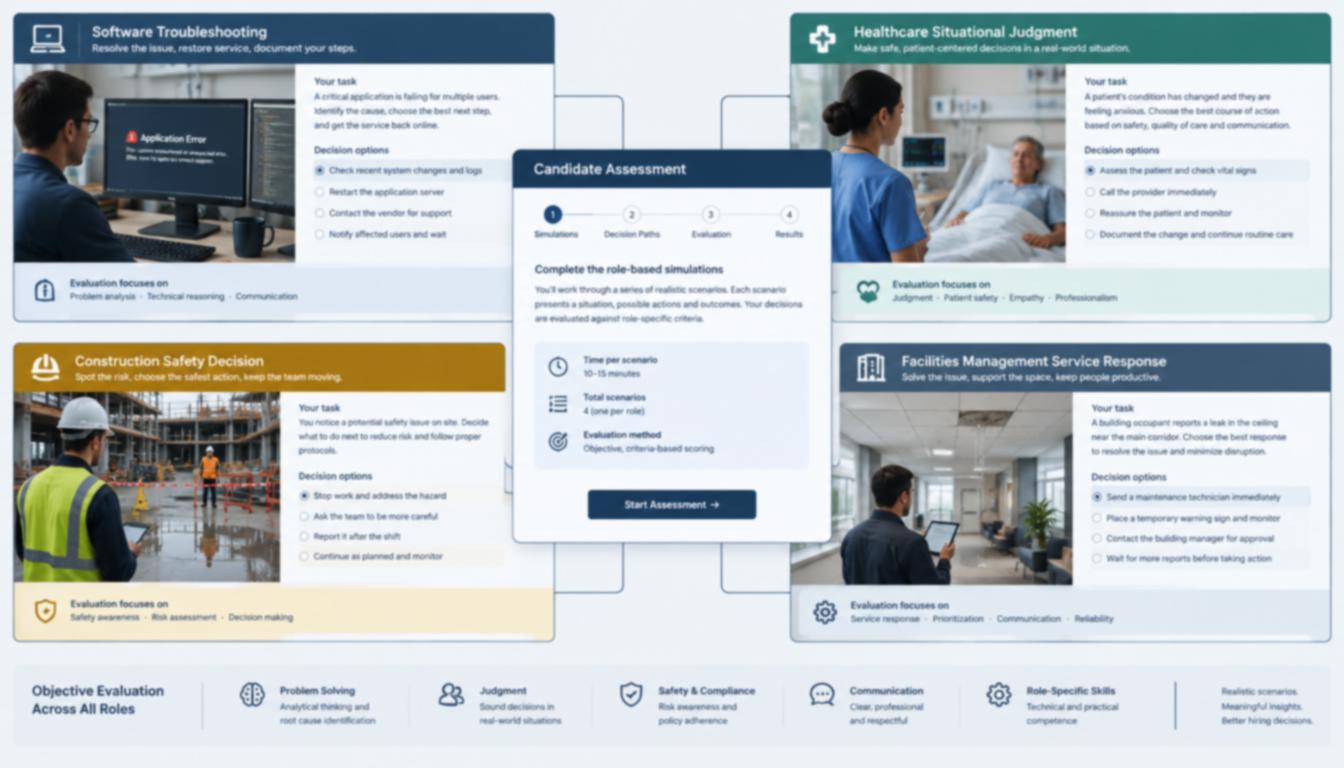
Resumes provide information about a candidate’s experience, but they do not always show how that person would handle the practical demands of a specific role. Job simulation assessments address this gap by placing candidates in structured, realistic scenarios that reflect workplace tasks and decisions.
For hiring teams in Technology, Healthcare, Construction, and Facilities Management, these assessments can provide a more direct way to evaluate practical execution. They can also support a skills-based hiring process by producing evidence about how candidates approach problems rather than relying only on self-reported resume claims.
The core shift to job simulation assessments
Manual resume screening is useful for identifying relevant experience, but it is an indirect method of evaluating capability. A resume may describe responsibilities, qualifications, or previous results without showing how a candidate would respond to a technical fault, a safety issue, a patient-related situation, or an operational disruption.
Job simulation assessments provide an alternative by asking candidates to complete tasks or make decisions in a controlled representation of work. The assessment does not attempt to reproduce every aspect of a job. Instead, it isolates practical competencies that are relevant to the role and creates a consistent basis for comparison.
This approach reflects a broader movement toward verifying practical skills alongside reviewing employment history. The Society for Human Resource Management’s discussion of predictive assessments reports that a majority of companies use pre-employment assessments to gain insight into candidates’ capabilities and potential.
The result is not a replacement for professional judgment. Rather, simulation results can give recruiters and hiring managers additional evidence to consider alongside interviews, qualifications, references, and other parts of the selection process.
Mechanics of scenario-based skill validation
Scenario-based skills assessment begins with a clear definition of the work that the candidate must perform. The assessment designer identifies the decisions, procedures, and problem-solving behaviors that are important for the role. Those elements are then translated into a series of realistic tasks or workplace situations.
A typical assessment may require candidates to:
- Review information and determine which details require attention.
- Choose an appropriate response to a developing situation.
- Prioritize tasks when several demands compete for attention.
- Apply a technical process or operational procedure.
- Explain or demonstrate the reasoning behind a decision.
Interactive simulations can make these tasks more representative of actual work than a purely theoretical test. For example, a technology candidate might be asked to identify the next step in resolving a system issue. A construction candidate might need to respond to a potential safety concern before continuing a task. These examples illustrate the assessment format; they do not represent a universal method for every role.
The assessment records defined actions and outcomes against predetermined criteria. Depending on the design, this may include accuracy, prioritization, procedural compliance, response time, or the quality of a decision. The criteria should be connected to the role and applied consistently across candidates.
Clear criteria are important because a simulation is only useful when it measures the intended competency. A scenario that tests general familiarity with a particular process may disadvantage candidates who have not used that process, even when they possess the underlying ability to learn it. Role analysis and validation are therefore central parts of practical skills assessment.
Industry application: Healthcare, Technology, Construction, and Facilities Management
Role-specific simulations are most informative when they reflect the context in which the skill will be used. A generic cognitive test may measure reasoning in the abstract, but specialized roles often require candidates to combine judgment with technical, procedural, or safety-related knowledge.
Healthcare and facilities management
Healthcare and Facilities Management roles can involve time-sensitive decisions, competing priorities, and the need to follow established procedures. A scenario-based assessment can present a situation in which the candidate must identify priorities, communicate an appropriate response, or determine which action should occur first.
For a healthcare-related role, the scenario might focus on situational judgment in a high-pressure environment. For Facilities Management, it could involve responding to a service disruption, coordinating a task, or recognizing a condition that requires escalation. The assessment should measure role-relevant judgment without suggesting that a simulated exercise can capture every requirement of real-world performance.
Technology and construction
Technology roles may require practical troubleshooting, structured analysis, and the ability to select an effective course of action from incomplete information. A simulation can present a technical problem and assess how the candidate interprets the available information, tests possible explanations, and determines the next step.
Construction roles may place greater emphasis on practical execution, sequencing, and safety compliance. A role-specific simulation can test whether a candidate recognizes a hazard, follows an appropriate procedure, or prioritizes actions before work continues.
These examples show why sector-specific design matters. A generic assessment may identify broad reasoning ability, but it may not reveal whether a candidate can apply that ability within the procedures and pressures of a particular occupation.
Workflow integration and ATS alignment
Job simulation assessments can be introduced at different points in the recruitment workflow. Some organizations may use them after an initial eligibility review, while others may place them earlier to provide practical evidence before an interview. The appropriate position depends on the role, the volume of applications, and the information required at each stage.
Integration with an Applicant Tracking System can reduce administrative work by connecting assessment invitations, candidate records, and results within the existing recruitment process. An Open API can support connections with ATS platforms such as Workday, Greenhouse, and Lever when the relevant technical configuration is in place.
Automation does not remove the need for human oversight. Hiring teams still need to define suitable criteria, monitor whether the assessment reflects the role, review outcomes in context, and provide candidates with an appropriate process. The purpose of integration is to make practical evidence easier to use, not to turn hiring into an entirely automated decision.
Interactive assessments can also support candidate engagement when the tasks are clearly explained, relevant to the role, and proportionate to the stage of hiring. A simulation should give candidates a meaningful opportunity to demonstrate practical ability rather than add complexity without a clear evaluation purpose.
Applying the approach in practice
A structured implementation typically begins with the role itself. Hiring teams can identify the practical competencies that distinguish effective performance, select realistic situations that test those competencies, and define the evidence required for consistent evaluation.
- Map the role requirements. Identify the decisions, tasks, procedures, and problem-solving behaviors that matter most.
- Design relevant scenarios. Use workplace situations that reflect the sector and level of responsibility without adding details that are unrelated to the role.
- Set evaluation criteria. Define how accuracy, prioritization, technical execution, or safety-related decisions will be assessed.
- Connect the assessment to the hiring workflow. Determine where the simulation belongs and how results will be reviewed alongside other evidence.
- Review the assessment periodically. Check whether the scenarios remain relevant and whether they measure practical capability rather than familiarity with the test format.
SectorPro provides interactive role-specific simulations designed to evaluate practical skills instead of relying only on CV claims. Its Open API supports ATS integration with Workday, Greenhouse, and Lever, allowing hiring teams to connect assessment activity with existing recruitment workflows.
For hiring managers evaluating this approach, a free SectorPro demo can provide a practical view of how interactive role-specific simulations operate in a recruitment process.
