
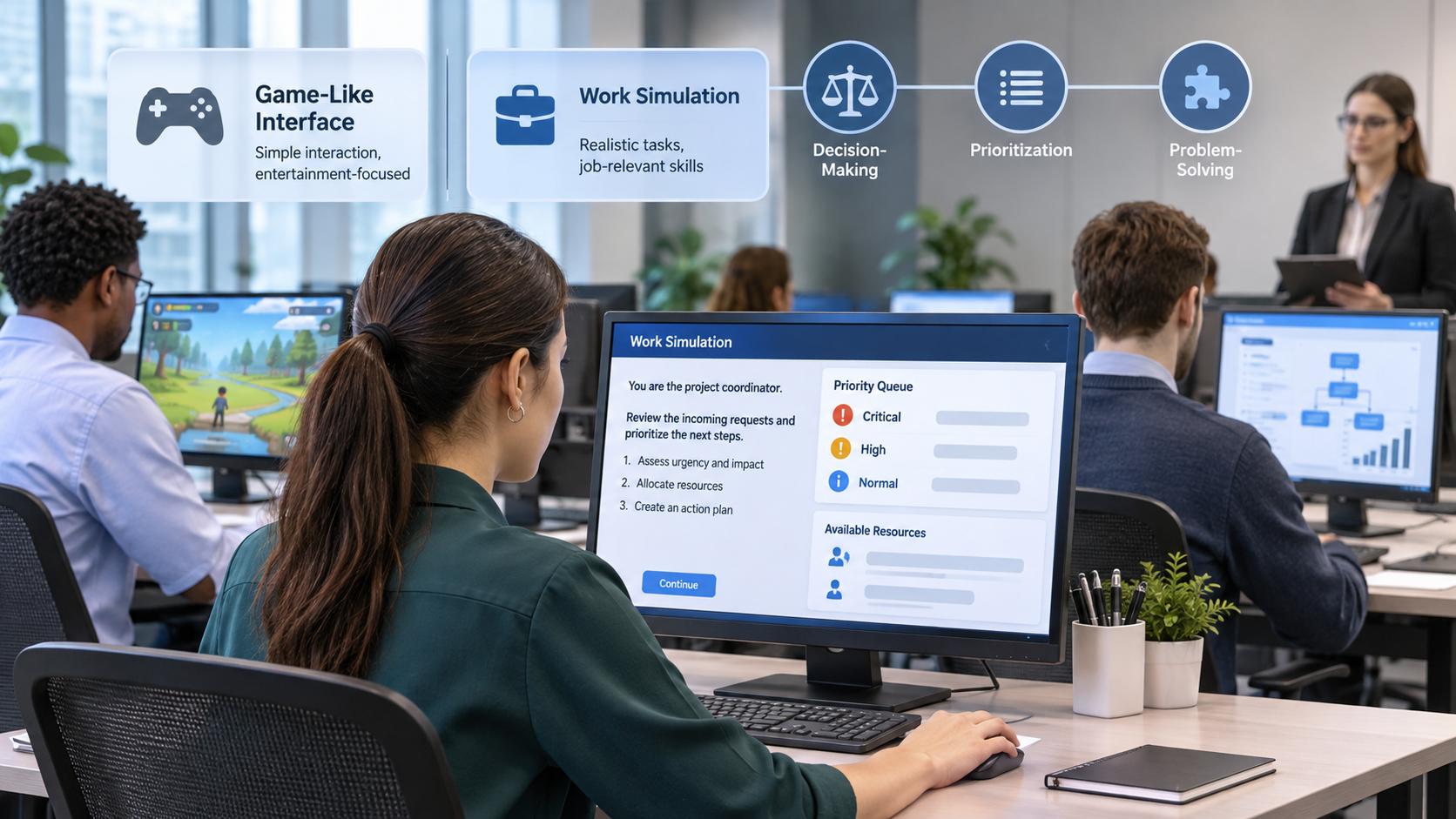
Game-based assessments are not inherently a gimmick. Their value depends on how they are designed, validated, and connected to the job. A professional game-based assessment uses interactive tasks to collect evidence about relevant cognitive or practical abilities, rather than adding points, badges, or animations for entertainment.
For conservative HR managers and operations directors, the central question is therefore not whether an assessment looks like a game. It is whether the assessment measures job-related competencies consistently, gives candidates a professional experience, and produces information that can support a fair hiring decision. When those conditions are met, game-based assessment candidate experience can be compatible with serious, evidence-based recruitment.
Why the gimmick label persists
Recruitment is a high-stakes process, particularly when an employer is selecting experienced professionals or hiring for roles with significant operational responsibility. A format that resembles a game may initially appear less formal than a structured interview, work sample, or traditional psychometric test.
That concern is understandable, but it can confuse the visual presentation of an assessment with its measurement model. A trivial gamification element might award points for speed or display progress without measuring a meaningful competency. A game-based assessment, by contrast, uses a structured task to observe specific responses and relate them to defined abilities.
The difference can be illustrated through a hypothetical example. A decorative leaderboard has little relevance if it does not measure anything connected to the role. An interactive scenario that requires prioritization, pattern recognition, resource allocation, or problem-solving may provide more relevant evidence when those abilities are part of the job.
A serious assessment should normally make several features clear:
- The task is connected to a competency or job requirement.
- The same assessment logic and scoring standards apply to candidates in comparable circumstances.
- The assessment measures more than familiarity with entertainment games.
- Instructions, time expectations, and technical requirements are communicated clearly.
- The results are interpreted as one part of a broader selection process.
This distinction is also addressed in the related analysis of whether gamified psychometric tests are appropriate for enterprise recruitment, which focuses on scientific rigor in professional assessment environments.
Gamification vs. game-based assessment
Gamification and game-based assessment are related but different concepts. Gamification adds game-like features to an existing process, such as progress indicators, challenges, rewards, or visual feedback. These elements may affect engagement, but they do not automatically make a process a valid assessment.
A game-based assessment uses an interactive task as the assessment itself. The task is designed to elicit observable behavior that can be scored or analyzed against a defined competency model. Depending on the design, the assessment may examine aspects of cognitive ability, decision-making, attention, planning, or role-specific problem-solving.
The term psychometric validity refers to whether an assessment measures what it is intended to measure and does so with sufficient consistency for its intended use. A game-based format does not guarantee validity. The relevant questions concern the underlying design: what the task measures, how it is scored, whether the task reflects the job, and whether the results can be interpreted responsibly.
Task-oriented simulations are particularly important because they move the focus away from entertainment and toward behavior. A candidate may be asked to respond to a changing situation, prioritize competing demands, or complete a practical sequence. The visual environment may be interactive, but the selection value comes from the competency evidence generated by the task.
Research discussed in Game based assessments of cognitive ability in recruitment: Validity, fairness and test-taking experience supports the use of game-based assessments for valid psychometric measurement and reports a more positive test-taking experience, including lower test anxiety compared with traditional tests. This does not mean that every game-based assessment is automatically valid. It means that the format can support credible measurement when the assessment is properly designed and evaluated.
Candidate experience and the age-bias myth
The phrase game-based assessment age bias often reflects a concern that older or more experienced candidates will reject interactive tools. That assumption treats age as a reliable proxy for a candidate’s willingness or ability to use unfamiliar technology. It also overlooks the factors that shape whether an assessment feels professional.
An interactive assessment does not need to be presented as entertainment. Clear instructions, a credible explanation of the purpose, relevant tasks, accessible technology, and a professional interface can make the process understandable to candidates from different professional and demographic backgrounds.
For an experienced candidate, a task that resembles an actual work situation may provide a clearer opportunity to demonstrate capability than an abstract question. This is not an argument that older candidates prefer games over interviews or traditional assessments. It is a reason to evaluate the relevance and usability of the assessment rather than infer acceptance from its appearance.
Candidate reactions can also be influenced by practical design choices. An assessment may create unnecessary friction if candidates do not understand:
- Why the assessment is being used.
- What skills or behaviors it is intended to examine.
- How long the process will take.
- Whether the assessment requires specific equipment or technical settings.
- How the results will contribute to the wider hiring process.
These considerations apply across age groups. A poorly explained assessment can create uncertainty for any candidate, while a transparent and job-relevant simulation can make the purpose easier to understand. The important distinction is between a playful surface and a professional assessment experience.
Candidate experience should also be assessed separately from visual novelty. An assessment can look modern while being confusing, or look interactive while remaining rigorous. A related discussion of job simulations, traditional assessments, candidate engagement, and drop-off examines this broader relationship between assessment format and the candidate journey.
Procedural fairness and psychometric validity
Game-based assessment validity depends on more than an attractive interface. For HR teams, procedural fairness provides a practical framework for evaluating whether an interactive assessment is appropriate for selection.
First, the assessment should measure competencies that are relevant to the role. A task that tests a candidate’s ability to manage a realistic work problem has a clearer selection rationale than a task that rewards familiarity with a particular type of game.
Second, the process should be administered and scored consistently. Candidates need comparable instructions, conditions, and expectations. Where accommodations are required, those accommodations should support access without changing the competency being assessed.
Third, the assessment should produce interpretable evidence. Results should not be treated as a complete representation of a candidate’s ability, personality, or future performance. They should be considered alongside other relevant evidence, including structured interviews, work samples, experience, and human judgment.
Fourth, employers should monitor whether the assessment creates unintended barriers. Interactive tools can reduce reliance on resume wording or narrow credential signals, but they do not automatically eliminate bias. Technical accessibility, language, disability accommodations, digital familiarity, and the relevance of the task all require attention.
These safeguards are central to procedural fairness. They also help answer a common concern about whether artificial intelligence or automated scoring removes the human role from recruitment. A responsible selection process uses assessment data to inform decisions while retaining appropriate human review and accountability.
The result is a more precise way to compare candidates. Instead of relying only on claims written in a resume or responses to static questions, an employer can examine evidence from a structured task. The value lies in the relevance and consistency of that evidence, not in the presence of game mechanics alone.
How to integrate serious simulations into recruitment
Employers considering game-based assessments can begin with the competency model rather than the technology. The first step is to identify which capabilities are genuinely important for the role. The second is to determine whether an interactive task can provide useful evidence about those capabilities.
A practical implementation process can include the following steps:
- Define the job-related competencies. The selection team should specify the skills or behaviors that matter before choosing an assessment format.
- Match tasks to competencies. Each mission or simulation should have a clear measurement purpose rather than serving as decoration.
- Explain the process to candidates. A concise explanation of the assessment’s purpose, format, timing, and role in the decision can support trust.
- Review accessibility and usability. Technical requirements and candidate support should be considered before the assessment is used at scale.
- Combine results with human evaluation. Interactive assessment data should contribute to a structured decision process rather than operate as an unexplained verdict.
- Evaluate the process over time. Employers should review completion patterns, candidate feedback, selection outcomes, and any evidence of unintended barriers.
SectorPro applies this approach through gamified tasks and interactive missions, simulations tailored to distinct sectors such as technology, healthcare, and construction, and active gamified challenges rather than passive multiple-choice tests. The purpose is to create opportunities for candidates to demonstrate practical, role-related capabilities in a structured format.
Further detail is available in the related article on job simulation assessments and evaluating practical skills beyond resume claims.
The practical conclusion for HR leaders
Game-based assessments are neither automatically credible nor automatically superficial. Their quality depends on the same fundamentals that apply to other selection tools: job relevance, sound measurement, consistent administration, accessibility, clear communication, and responsible interpretation.
The strongest response to the gimmick concern is therefore not to defend every interactive assessment. It is to distinguish serious game-based assessment from decorative gamification. A well-designed simulation can provide structured evidence about cognitive and practical skills while offering a candidate experience that does not depend on lengthy, abstract questionnaires.
HR leaders evaluating this approach can book a free SectorPro demo to see how professional gamified assessments, sector-specific simulations, and interactive missions can be used to evaluate practical skills without making entertainment the point of the selection process.
