
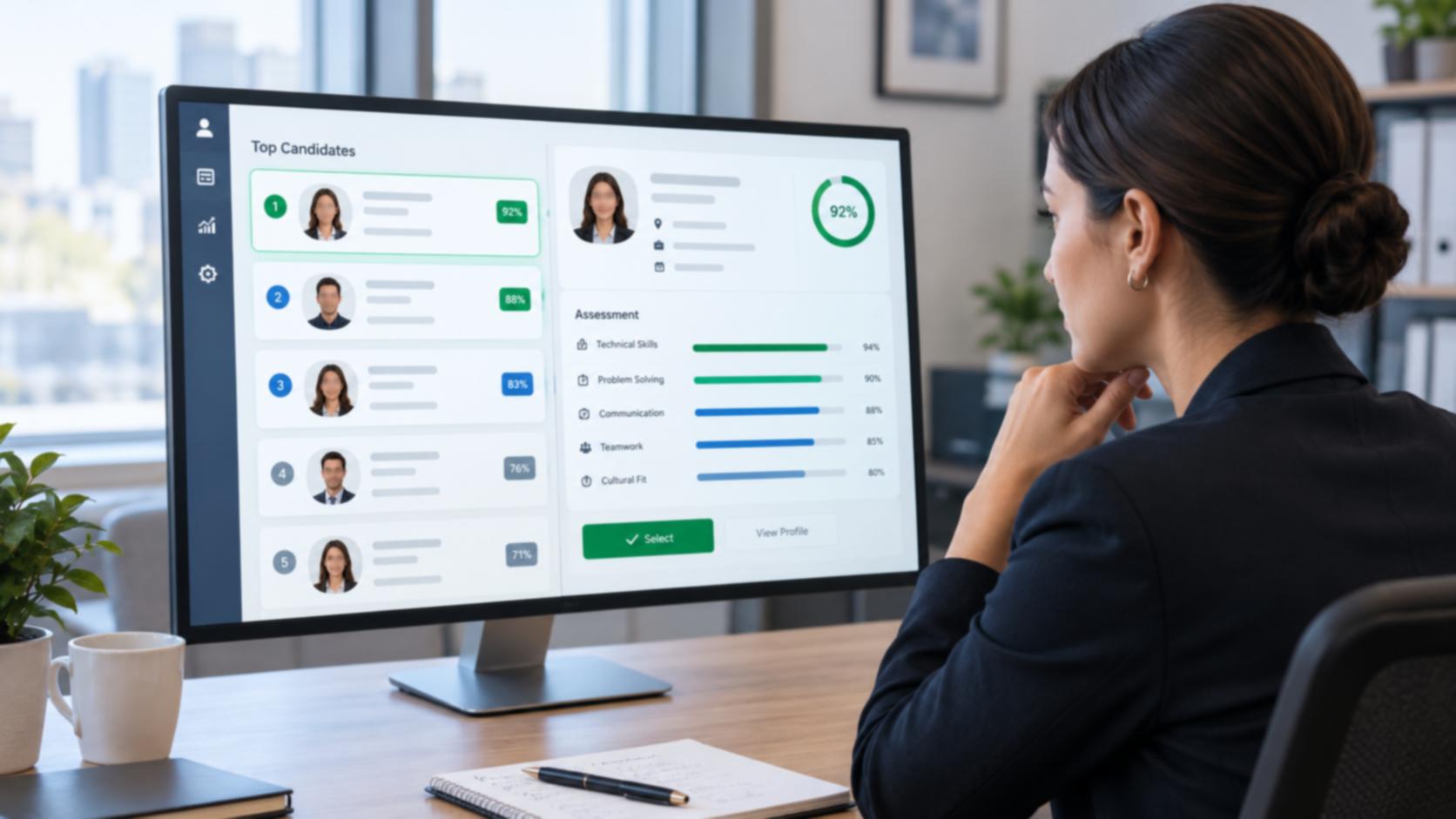
AI candidate ranking is a decision-support process that helps recruitment teams sort and prioritize applicants using defined job-related data. It does not need to determine who is hired. Instead, it can reduce the administrative work involved in early screening, leaving recruiters responsible for interpreting context, conducting interviews, and making final hiring decisions.
For HR teams managing a large applicant pool, the central value of AI candidate scoring is speed with structure. A system can process assessment results and other relevant inputs consistently, then present a prioritized shortlist for human review. The quality of the final decision, however, still depends on the criteria selected, the data reviewed, and recruiter judgment.
The transition to AI-assisted candidate screening
Manual CV review requires recruiters to compare large volumes of applicant information against a role’s requirements. This work can be administratively demanding, particularly when an organization is hiring at scale. It can also lead to inconsistent early-stage comparisons when reviewers assess applications differently or under time pressure.
AI-assisted candidate ranking introduces a structured way to triage applicants. Rather than asking a recruiter to begin with every resume in the same queue, the system can organize candidate information according to criteria established for the role. This gives the recruitment team a clearer starting point for review.
Structured screening can support a more objective early evaluation when the criteria are relevant to the role and applied consistently. It does not, by itself, remove the need to examine whether those criteria are appropriate or whether the process is producing fair outcomes. Human oversight remains necessary throughout the workflow.
For related context on evaluating skills before a recruiter reviews candidates, see replacing resume screening with skills-based validation for high-volume hiring.
How AI candidate ranking algorithms evaluate applicants
AI candidate scoring begins with inputs selected for a specific hiring process. These may include role requirements, structured candidate responses, and results from job-relevant capability assessments. The system processes those inputs against the defined criteria and assigns a score, ranking, or priority category that recruiters can use to organize review.
The result is not a hiring verdict. It is a ranked view of available information. A candidate placed higher on a shortlist may appear to align more closely with the selected criteria, but the ranking does not capture every factor relevant to employment. Recruiters still need to assess interview performance, team context, candidate motivations, and other information that requires human interpretation.
From assessment data to a prioritized shortlist
A practical scoring workflow usually follows a clear sequence:
- The organization defines the capabilities and requirements relevant to the role.
- Candidates complete the applicable screening or assessment steps.
- The system processes the resulting data against the established criteria.
- Recruiters receive a prioritized shortlist and review the underlying information before deciding who progresses.
This approach shifts initial screening from a purely document-based exercise toward a review of structured, role-related evidence. The score should be treated as one input in a wider selection process, not as a substitute for professional judgment.
Predictive analytics can add another layer of decision support by identifying patterns in the available assessment data. Its usefulness depends on the relevance of the inputs and the way recruiters interpret the output. A prediction is an indicator for review, not a guarantee about a candidate’s future performance or retention.
A related article, how predictive psychometric testing can reduce employee turnover, examines the role of predictive evaluation in recruitment decisions.
Augmenting rather than replacing human judgment
The distinction between screening support and autonomous hiring is important. AI ranking can handle repetitive early-stage sorting, but recruiters retain authority over the process. They decide which criteria matter, review shortlisted candidates, investigate exceptions, conduct interviews, and make the final selection.
This division of responsibilities allows technology to support administrative efficiency without removing human accountability. Recruiters can spend less time manually ordering applications and more time evaluating evidence, speaking with candidates, and considering the circumstances that a ranking cannot fully represent.
The Society for Human Resource Management describes AI as a recruitment decision-support tool that can improve efficiency through candidate filtering while preserving human authority over final hiring evaluations in The Evolving Role of AI in Recruitment and Retention.
Responsible use also requires recruiters to examine the process regularly. Teams should confirm that scoring criteria remain connected to the role, review outputs for unexpected patterns, and ensure that a candidate can receive meaningful human consideration. A prioritized list should guide attention, not close off it.
Where demographic information is handled separately during early evaluation, organizations may also consider how that approach supports a more objective process. For further reading, see how blind resume screening reduces demographic bias in early hiring.
Integrating automated scoring into the HR workflow
AI candidate ranking is most useful when it fits the systems recruiters already use. An Applicant Tracking System, or ATS, is typically the operational record for applications, pipeline stages, recruiter notes, and hiring activity. Connecting scoring tools to that workflow can reduce duplicate data handling and make prioritization easier to review in context.
SectorPro provides AI-powered predictive analytics and automated candidate ranking and scoring to support HR teams during early-stage evaluation. Its Open API supports integration with ATS platforms including Workday, Greenhouse, and Lever. This allows relevant ranking information to be incorporated into an established recruitment workflow while recruiters maintain control of progression and final selection decisions.
For implementation, recruitment teams should begin by defining what a score is intended to support. A ranking may help determine review order, identify candidates for an initial conversation, or flag cases that warrant closer inspection. The workflow should also establish who reviews the results, what information remains outside the score, and where final approval occurs.
Combining automated screening with human review can create a more organized process: technology handles repeatable sorting, while recruiters apply judgment to the hiring decision. That balance is the practical answer to whether AI replaces recruiters. It can assist their work, but it does not remove the need for accountable human evaluation.
Evaluating AI ranking without giving up control
HR teams considering automated scoring should evaluate the process behind the output, not only the score itself. Relevant questions include whether the criteria reflect the role, whether recruiters can review the information supporting a ranking, and whether the ATS workflow preserves clear human approval points.
Organizations evaluating SectorPro can schedule a free demo to review how its automated candidate ranking and predictive analytics can integrate with their existing ATS workflow. The demonstration can help teams assess whether the platform’s decision-support model aligns with their recruitment process and oversight requirements.
