
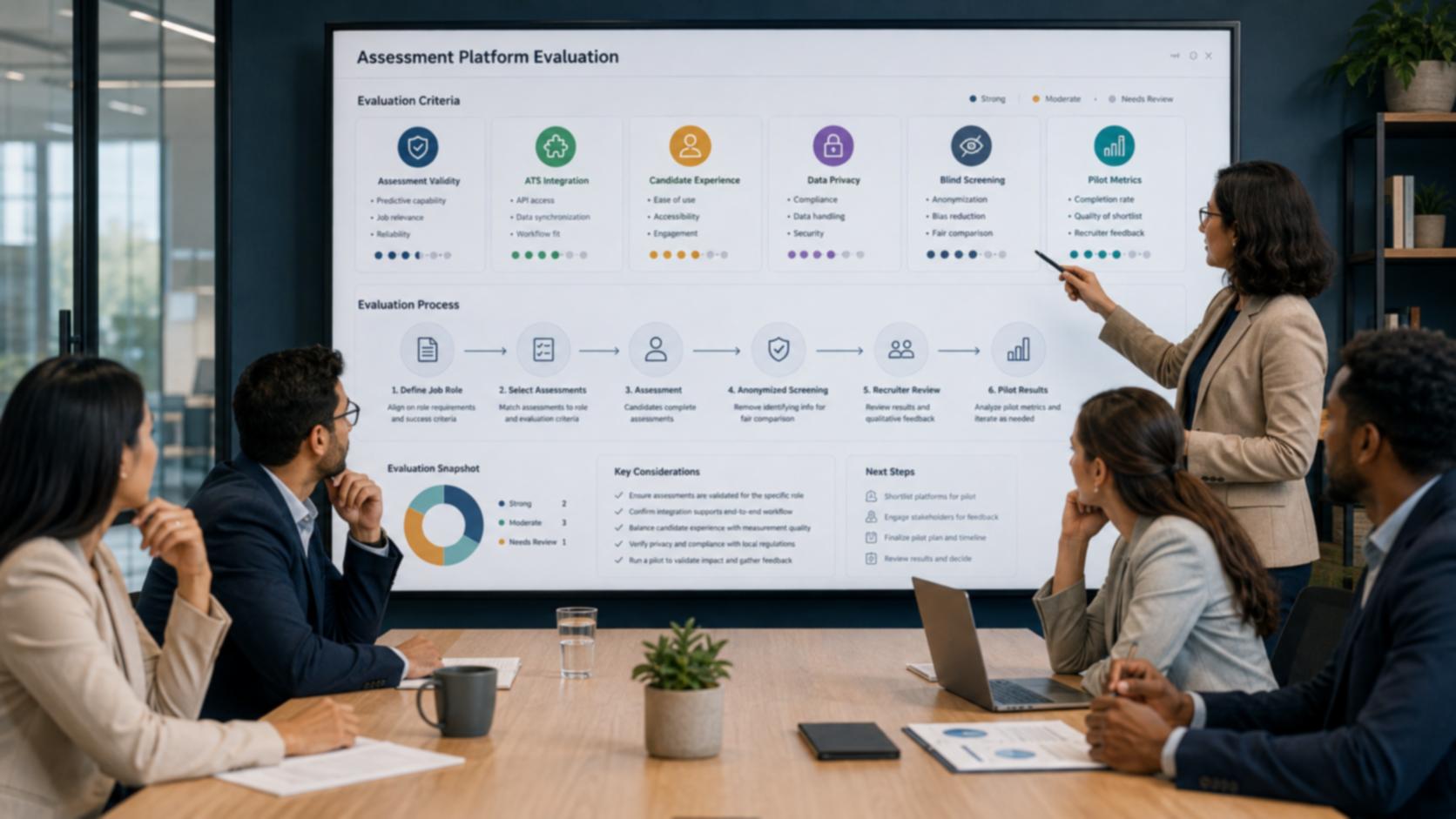
Choosing pre-employment assessment software requires more than reviewing a feature list. HR decision-makers need to determine whether an assessment platform produces job-related insights, fits existing recruitment workflows, protects candidate data, and provides a fair candidate experience. A software demonstration is most useful when those criteria are defined before the meeting.
This evaluation framework covers the main criteria for comparing talent assessment tools, preparing for an HR software demo, asking informed questions, and structuring a controlled pilot. It also shows how capabilities such as blind screening, ATS integration, encryption, and sector-specific modules can be assessed in practical terms.
The framework for evaluating talent assessment tools
The strongest evaluation process begins with the hiring problem the platform is expected to address. A company managing high application volumes may prioritize screening efficiency, while another organization may focus on validating practical skills, improving diversity, or understanding longer-term role alignment. The assessment criteria should reflect those objectives.
A transition from manual resume review to skills-based testing can help an organization examine capabilities that are not easily established through CV claims alone. The related guide on replacing resume screening with skills-based validation provides additional context for that shift. However, an assessment tool should be evaluated on evidence and process quality rather than on the novelty of its interface.
Scientific validity and job relevance
Validity is the first evaluation pillar. The assessment should measure competencies that are relevant to the role, use a defensible scoring method, and provide an understandable explanation of how results should inform hiring decisions. A game-like format or predictive score does not, by itself, demonstrate that an assessment is suitable for employment decisions.
Legal and methodological review should form part of the evaluation. The U.S. Equal Employment Opportunity Commission guidance on employment tests and selection procedures supports the requirement that pre-employment tests should be properly validated and job-related to help ensure compliance with anti-discrimination laws. Organizations operating in other jurisdictions should also assess the requirements that apply to their own hiring processes.
Decision-makers should ask what construct the assessment measures, how that construct relates to job performance, whether the scoring model has been validated for the intended role, and how the results should be interpreted. If predictive analytics are included, the provider should explain the evidence supporting those predictions and the limits of the output.
Integration and workflow fit
An assessment platform should fit the organization’s existing recruitment process. Evaluation should cover candidate invitations, result transfers, recruiter review, permissions, reporting, and the handoff between the assessment platform and the applicant tracking system.
API compatibility is only one part of the question. The buyer should also establish which data moves between systems, how errors are handled, what configuration work is required, and which team owns the integration. SectorPro, for example, documents an open API for ATS integration with Workday, Greenhouse, and Lever. Those integrations can serve as a benchmark during a demonstration, but the buyer should verify how the proposed workflow would operate in the organization’s own environment.
Candidate experience and data protection
The assessment should be accessible, understandable, and proportionate to the role. A buyer should examine the instructions presented to candidates, the expected completion time, accessibility considerations, mobile or browser requirements, and the process for handling technical difficulties. Candidate experience should be evaluated alongside assessment quality because unnecessary friction can affect completion rates and the perception of the employer.
Data protection requires equal attention. The evaluation should cover data storage, encryption, retention, access controls, deletion procedures, processor responsibilities, and support for applicable privacy obligations. SectorPro documents GDPR compliance and AES-256 encryption as part of its platform capabilities. These claims should still be translated into specific operational questions during a demo, including where data is stored, who can access it, and how candidate requests are handled.
The HR software demo checklist and preparation process
A structured demonstration allows the buyer to compare platforms against the same requirements. Preparation should involve the people who will approve, administer, integrate, and use the system. This may include HR leadership, recruiting operations, hiring managers, information technology, legal or privacy specialists, and representatives responsible for diversity and inclusion.
Define the decision criteria before the meeting
The evaluation team should convert broad objectives into measurable questions. A practical checklist can include:
- Whether the assessment measures job-related capabilities and provides evidence of validity.
- How the platform supports skills-based evaluation and role-specific assessment design.
- How demographic information is handled during initial screening and scoring.
- Which ATS platforms are compatible and what implementation work is required.
- How candidate data is encrypted, retained, accessed, and deleted.
- How candidates receive instructions, accommodations, support, and results-related information.
- Which reports are available to recruiters and hiring managers.
- How the platform supports a controlled pilot and comparison with the current process.
The team should distinguish mandatory requirements from preferences. This prevents an attractive demonstration from obscuring a missing compliance, workflow, or integration requirement.
Bring baseline recruitment metrics
A provider can demonstrate a workflow more meaningfully when the buyer supplies baseline information. Useful measures may include time-to-hire, time spent on resume screening, the number of applicants per vacancy, assessment completion rates, interview conversion rates, offer acceptance, and turnover rate. The data does not need to be perfect, but its definitions and measurement period should be clear.
Baseline metrics also support a more disciplined pilot. For example, the evaluation team can compare the time required to review a defined applicant group, the proportion progressing to the next stage, and the quality of shortlisted candidates according to agreed criteria. The purpose is to establish evidence for the decision rather than to assume that automation will produce a particular result.
Plan the demonstration around a real workflow
The demonstration should follow a representative hiring process rather than a generic product tour. The provider can be asked to show how a role is configured, how candidates are invited, how results are reviewed, how demographic information is treated during initial screening, and how data is transferred to the ATS.
Internal stakeholders should record observations against the same scorecard. The assessment can then cover usability, relevance, security, integration, reporting, implementation effort, and candidate experience. A consistent scorecard makes it easier to compare platforms and identify questions that require written follow-up.
Crucial questions to ask during an HR software demo
Specific questions help reveal the difference between a documented capability and a general product claim. Questions about AI, compliance, and integration should be answered in terms that HR, legal, and technical stakeholders can evaluate together.
Questions about AI evaluation and predictive analytics
- Which candidate behaviors, responses, or capabilities contribute to the assessment result?
- How is the scoring model validated for a particular role or sector?
- What evidence supports any predictive relationship between assessment results and later outcomes?
- How are false positives, false negatives, and uncertain results identified?
- Can recruiters understand the factors behind a score without treating it as an automatic hiring decision?
- How is human review incorporated into the recruitment workflow?
These questions help prevent an organization from treating an algorithmic score as a substitute for professional judgment. They also clarify whether predictive analytics are being used as decision support or presented as a definitive conclusion.
Questions about fairness, privacy, and security
- How does the platform support blind screening and demographic anonymization during initial evaluation?
- Which demographic fields are hidden, and at what stage can authorized users access them?
- What documentation describes the platform’s GDPR compliance responsibilities?
- How is AES-256 encryption applied to stored or transmitted data?
- What are the retention and deletion procedures for candidate information?
- How are access permissions, audit records, and data-processing responsibilities managed?
SectorPro’s algorithmic blind screening capability can be used as a reference point for this part of the discussion. The evaluation should focus on the actual workflow and controls rather than assuming that anonymization alone removes every possible source of bias.
Questions about integration and implementation
- Is the organization’s ATS supported, and which data fields can be exchanged?
- What configuration, testing, and approval steps are required before launch?
- What is the expected implementation timeline for a defined pilot scope?
- Which team provides technical support during integration?
- How are failed transfers, duplicate records, and changes to a hiring workflow handled?
- What information is available to recruiters inside the assessment platform and the ATS?
For SectorPro, the documented open API and compatibility with Workday, Greenhouse, and Lever provide concrete topics for this discussion. A buyer should still request a workflow demonstration using the organization’s intended process and data requirements.
Structuring a pilot screening workflow
A pilot should be narrow enough to manage and realistic enough to produce useful evidence. The evaluation team should select one or more roles with clearly defined competencies, an agreed candidate population, and stakeholders who can review the results.
Scope the role and assessment module
The first step is to define the role, hiring volume, assessment stage, success criteria, and decision owners. Sector-specific talent matching modules may be relevant when the role requires context-specific capabilities in areas such as technology, healthcare, construction, or cleaning. The module should be assessed against the actual requirements of the selected role rather than chosen solely because it is industry-specific.
The pilot plan should document which assessment results are used, who can view them, how they influence progression, and which decisions remain with recruiters and hiring managers. Candidate communications should explain the purpose of the assessment and provide an appropriate support route.
Implement blind screening in a controlled environment
If blind screening is part of the pilot, the team should define which demographic information is anonymized, when it becomes available, and how authorized reviewers can access it later in the process. The same role criteria should be applied to the pilot group so that the evaluation does not change midway through the test.
The organization should also record exceptions, technical issues, incomplete assessments, and requests for accommodation. These details are necessary for judging operational feasibility and candidate experience, not just scoring performance.
Measure initial ROI and decision quality
Pilot results should be compared with the agreed baseline. Relevant measures may include recruiter screening time, time to shortlist, candidate completion, progression rates, interview quality, implementation effort, and user feedback. If turnover or retention is included, the evaluation team should recognize that a short pilot may not provide enough time to establish a reliable long-term relationship.
The final review should combine quantitative measures with structured feedback from recruiters, hiring managers, candidates, privacy specialists, and technical stakeholders. A platform should proceed to broader adoption only when it meets the required validity, workflow, privacy, and candidate-experience criteria.
Making the final evaluation decision
Effective evaluation of pre-employment assessment tools is a process of evidence gathering. The buyer should define the hiring problem, establish assessment and compliance criteria, prepare a consistent HR software demo checklist, ask detailed questions, and run a controlled pilot against baseline measures.
SectorPro can be included in that evaluation as a documented example of capabilities such as algorithmic blind screening, an open ATS integration API, GDPR compliance, AES-256 encryption, and sector-specific talent matching modules. HR leaders who want to examine those capabilities in a live workflow can schedule a free SectorPro demo and use the framework to structure the discussion.
