
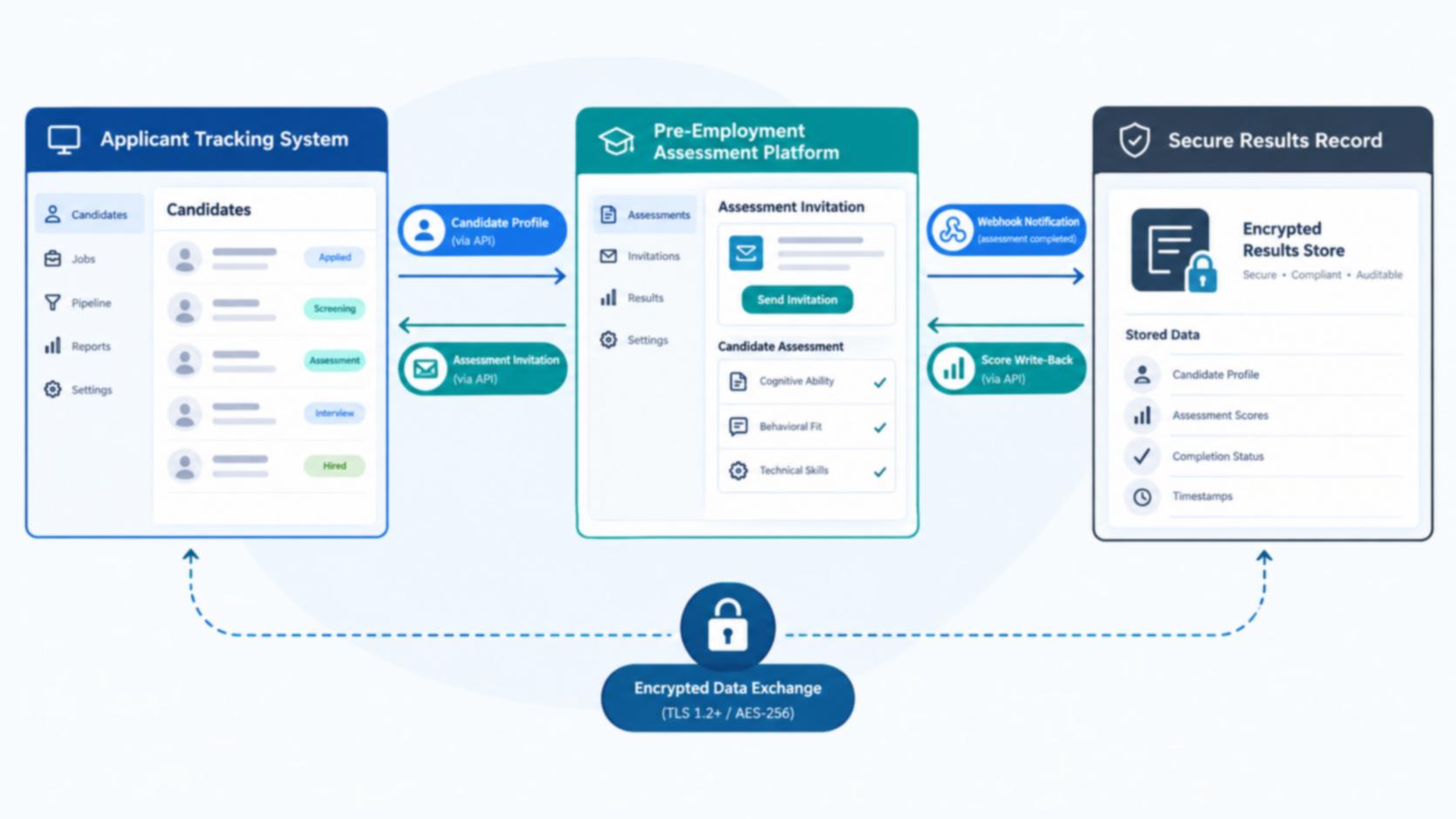
A successful pre-employment assessment ATS integration depends on more than a basic data connection. Recruitment teams need a defined workflow for sending candidate records to an assessment platform, triggering the right actions at the right recruitment stage, and returning results to the applicant tracking system without duplicate records or manual re-entry.
For organizations using Workday, Greenhouse, or Lever, the central requirement is an API integration that supports reliable two-way data exchange. Technical teams should also confirm how the integration handles authentication, event notifications, score write-backs, candidate status updates, encryption, and GDPR responsibilities before selecting a provider.
The role of Open APIs in pre-employment assessment integration
An Open API is a documented interface that allows separate software systems to exchange information through defined requests and responses. In a recruitment workflow, it can connect an ATS with an assessment platform so candidate records and assessment outcomes move between systems without relying on spreadsheets or repeated manual entry.
Manual data entry and CSV imports can create operational risk when candidate volumes increase. A recruiter may need to export candidate details, upload them into an assessment tool, monitor completions separately, and then transfer outcomes back to the ATS. Each handoff can introduce duplicate records, incomplete information, inconsistent status labels, or delays in follow-up.
With a pre-employment assessment ATS integration, the ATS can remain the system of record. The assessment platform receives the information needed to administer an assessment, while the ATS retains the candidate profile, recruitment stage, and hiring workflow.
Two-way exchange is particularly important. The integration should support both of the following directions:
- ATS to assessment platform: candidate identifiers, contact details, role or requisition information, and the event that initiates an assessment.
- Assessment platform to ATS: completion status, assessment outcome, score data, ranking information where applicable, and a link or reference to additional candidate results.
Major ATS environments may have their own integration models and technical documentation. For example, Greenhouse Developer Resources provides developer documentation for Assessment APIs that enable third-party assessment platforms to integrate with Greenhouse. This illustrates why evaluators should confirm requirements against the specific ATS environment rather than treating every API connection as identical.
Core technical requirements for ATS synchronization
Reliable synchronization requires a clear data model and defined event flow. Before an integration is activated, technical and HR stakeholders should agree on which system creates each record, which identifiers connect records across platforms, and which fields must remain synchronized.
Candidate identifiers and field mapping
Candidate matching should rely on a stable identifier supplied by the ATS, rather than a name or email address alone. The integration should preserve that identifier when the assessment invitation is created and when results return to the ATS. This reduces the risk that one candidate’s assessment is associated with another candidate record.
Field mapping should also be documented. At a minimum, teams should determine how the following information is exchanged:
- Candidate and application identifiers
- Job, requisition, or role identifiers
- Assessment invitation and completion status
- Assessment score or outcome fields
- Candidate ranking or scoring data, where the platform provides it
- Error messages, failed invitations, or incomplete records
Not every field should necessarily be copied into the ATS. Recruitment teams should decide which results support a hiring decision and which data belongs in the assessment platform. This approach can make ATS records easier to review while maintaining an auditable connection to the underlying assessment outcome.
Webhooks and stage-based triggers
Webhooks are event notifications sent from one system to another when a defined action occurs. In an ATS assessment workflow, a webhook can notify the assessment platform when an applicant reaches a selected hiring stage. The platform can then create or issue the assessment without a recruiter separately initiating the task.
A stage-based workflow should be precise. For example, an organization may configure an assessment only after an applicant is moved to a designated screening stage. The implementation should define what happens if the candidate is moved backward, withdrawn, rejected, or advanced before completing the assessment.
Technical teams should also verify how failed events are handled. A webhook delivery failure, temporary service interruption, or incomplete candidate record should be visible to the appropriate administrator. A dependable workflow includes a way to identify exceptions and prevent candidates from being silently excluded from the process.
Automated write-backs to the system of record
When an assessment is completed, relevant results should write back to the ATS in a format recruiters can use in the existing workflow. This may include a completion status, score, recommendation field, or ranking data, depending on the assessment platform and the ATS configuration.
The write-back process should be tested for both normal and exceptional outcomes. Teams should confirm how the integration records incomplete assessments, expired invitations, resubmissions, and assessment failures. They should also establish whether updated results replace prior values, create a new activity record, or require human review.
SectorPro documents an Open API for ATS integration with Workday, Greenhouse, and Lever. Its documented capabilities also include automated candidate ranking and scoring. During an evaluation, the relevant question is not simply whether an API exists, but whether the required candidate data and result fields can be exchanged within the organization’s established ATS workflow.
Data security and compliance during integration
An API connection may exchange personal data, including candidate contact details, application information, and assessment outcomes. Security and compliance requirements therefore need to be assessed as part of the integration design, not after deployment.
Evaluators should request clear information on how data is protected during exchange, how access is authenticated, and which personnel or systems can access integration credentials. Access should be limited to the permissions required for the workflow. Credentials should be managed through an approved process rather than shared across individual users or stored in unsecured locations.
SectorPro documents end-to-end data encryption using AES-256 and GDPR compliance. Organizations should still validate how these controls apply to their specific integration configuration, including data fields, API endpoints, retention policies, and administrator access.
GDPR compliance requires attention to the full data flow. When applicant records synchronize across platforms, the organization should understand:
- Which personal data fields are transferred
- Why each field is necessary for the assessment workflow
- Where data is processed and retained
- Which party is responsible for access requests, correction requests, and deletion requests
- How assessment results are retained or removed when a candidate record changes status
These questions are particularly important where data is copied rather than referenced. A related guide to pre-employment assessment GDPR compliance and data security can help evaluators frame the privacy and security checks needed during platform selection.
Validating workflow continuity during software evaluation
Integration claims should be tested against a realistic recruitment process. A software demonstration can establish whether the available connection supports the organization’s ATS, but a structured evaluation should also examine the detail of the workflow.
HR and technical stakeholders can use a shared validation checklist:
- Map the current workflow. Identify the ATS stages where an assessment should be initiated, reviewed, and completed.
- Define the record owner. Confirm that the ATS remains the authoritative source for candidate and application records where that is the intended operating model.
- Review data mapping. Verify the candidate identifiers, requisition fields, statuses, scores, and ranking data that will be exchanged.
- Test key scenarios. Include completed assessments, incomplete assessments, withdrawn candidates, duplicate records, failed invitations, and status changes.
- Review exception handling. Determine who receives integration errors, how they are resolved, and how missed events are identified.
- Confirm security controls. Review authentication, access permissions, encryption, and GDPR responsibilities with relevant security and privacy stakeholders.
Evaluation should focus on workflow continuity, not merely the presence of an integration label. A connection that transfers only a completion status may be sufficient for one recruitment process, while another may require score write-backs, ranking information, and role-specific field mapping.
Recruitment teams can use this guide to evaluating pre-employment assessment tools before a software demo to prepare integration questions for vendors and internal stakeholders.
Integration requirements should be defined before selection
A pre-employment assessment ATS integration should be evaluated as an operational workflow rather than a standalone technical feature. The critical requirements are an appropriate API connection, dependable event triggers, accurate candidate matching, useful result write-backs, controlled exception handling, and documented data protection practices.
For organizations assessing SectorPro, a free demo can be used to review its Open API compatibility with Workday, Greenhouse, and Lever, along with the assessment data and synchronization workflow required for the organization’s ATS environment.
